INTRODUCTION
A cockroach spotted in the kitchen at 11pm rarely waits for business hours. Neither do termites, which can chew through structural timber for months before anyone notices a problem. That's the reality behind most calls for pest control in Sydney homes and businesses make: the issue has usually been building quietly, and the person calling wants it handled today.
Sydney's climate is part of the problem. Warm, humid summers and mild winters keep cockroaches, ants, spiders, rodents and termites active for most of the year, which is why fast, licensed treatment matters here more than in cooler cities. This guide covers what a professional treatment involves, which pests cause the most damage locally, how to check a company is properly licensed, what a same-day visit looks like, and what drives the price up or down.
Who this is for: homeowners, renters arranging an end-of-lease treatment, landlords, strata managers and small business owners who need a fast, licensed response.
TABLE OF CONTENTS
What Does Pest Control in Sydney Actually Involve?
Common Pests in Sydney Homes and Businesses
Signs You Need Professional Pest Control
How to Choose a Licensed Pest Control Company in Sydney
What Happens During a Same-Day Pest Treatment
Termite Control in Sydney: What Every Homeowner Should Know
Pest Control Costs in Sydney: What Affects the Price
DIY vs Professional Pest Control: When Each Makes Sense
What Does Pest Control in Sydney Actually Involve?
Professional pest control is defined as the licensed inspection, treatment and prevention of insects, rodents and other pests using EPA-registered chemicals, baits, traps and physical barriers. It isn't the same as a supermarket can of surface spray. A licensed technician identifies the species, finds entry points and nesting sites, and applies the right product for that pest in a way that keeps people, pets and food areas safe.
Pest control services Sydney providers typically offer fall into three categories: general pest treatment (cockroaches, ants, spiders, silverfish, usually with a 6–12 month warranty), termite and timber pest services (inspection, monitoring and barriers rather than a single spray), and commercial or strata pest management, which often has to meet food-safety or health regulations rather than just personal preference.
In my experience, the biggest misunderstanding customers have is treating "pest control" as one single service. A property with both cockroaches and a termite issue usually needs two separate treatment plans on two different timelines, because the products and techniques don't overlap. A good technician explains this upfront rather than bundling everything into one quote. Sydney's mix of older weatherboard homes, dense apartments and coastal humidity means no two properties face quite the same pest combination, which is why a proper inspection beats a generic spray-and-go visit.
Common Pests in Sydney Homes and Businesses
Sydney's humid, coastal climate and long warm season create near-ideal breeding conditions for several pest species. Identifying the right one shapes the entire treatment approach.
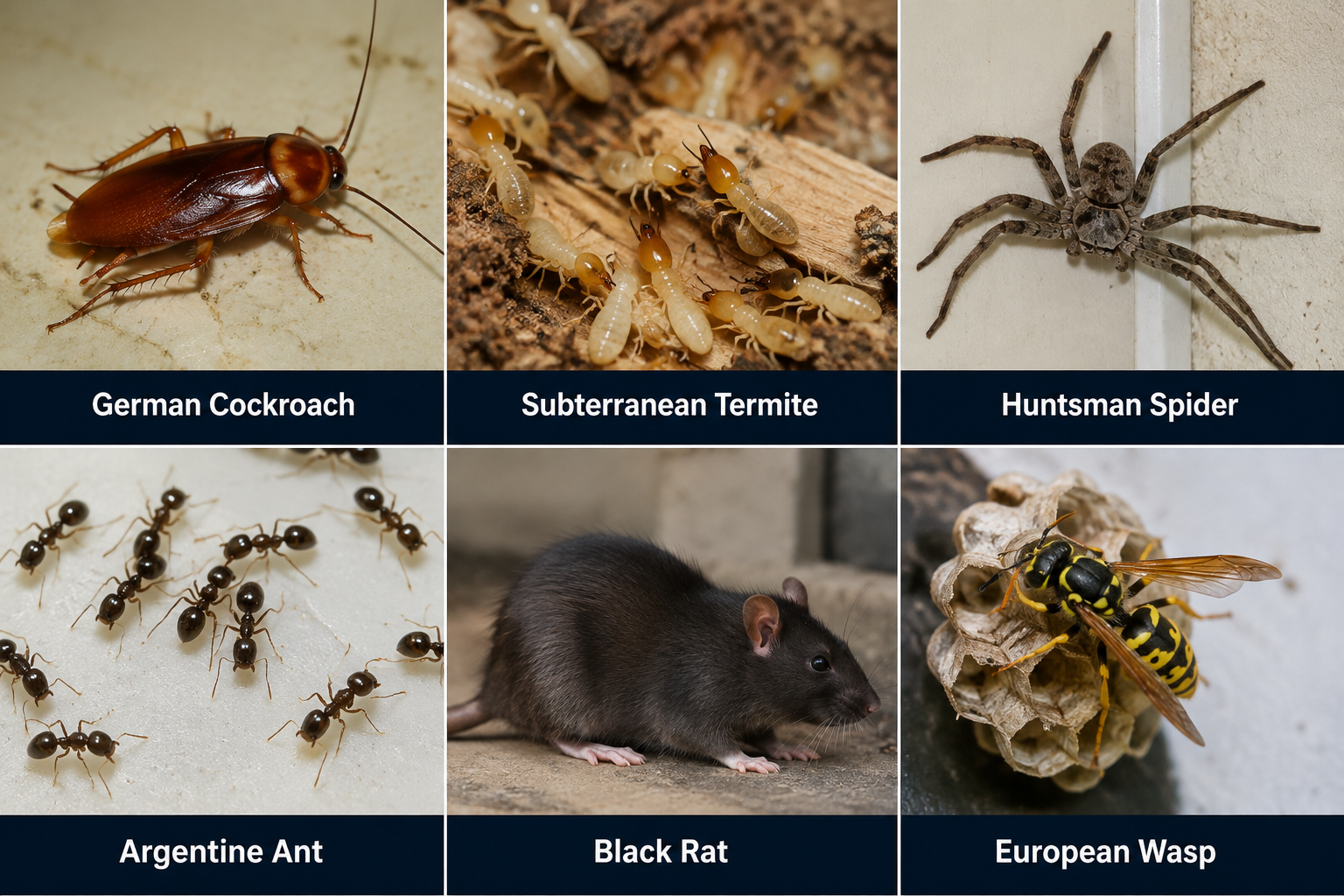
Cockroaches — German and American cockroaches thrive in kitchens, drains and roof voids year-round.
Termites — Subterranean termites are active across almost all of NSW and damage timber with no visible surface signs.
Ants — Argentine and black house ants form large colonies and move indoors for food and moisture after rain.
Spiders — Huntsman, redback and black house spiders are common around eaves and garages in warmer months.
Rodents — Rats and mice move into roof cavities as weather cools, chewing wiring and food packaging.
Wasps and bees — European wasp nests peak in late summer and early autumn and carry a sting risk if disturbed.
Coastal suburbs tend to see heavier ant and cockroach activity due to humidity, while leafy inner and northern suburbs report more termite and spider callouts. A property near bushland carries a different risk profile to a CBD apartment, which is why a local inspection beats a one-size-fits-all plan.
Signs You Need Professional Pest Control
Problem: Many homeowners wait until pests are visibly swarming before calling for help, by which point an infestation is often well established.
Cause: Most pests operate out of sight — in wall cavities, under flooring, in roof voids or below the soil line — so the first visible sign is usually a late-stage symptom, not the start of the problem.
Solution: Watch for these early indicators and book an inspection before the issue escalates:
Discarded insect wings near windowsills (often a termite swarm indicator)
Fine sawdust-like material near skirting boards
A persistent musty odour in one part of the house
Scratching noises in the ceiling at night
Droppings along skirting boards or in cupboards
Cockroaches active in daylight, which usually signals a large hidden population
A common mistake I see is treating a single sighting as a one-off rather than booking an inspection. One cockroach seen in daylight can represent a colony of several hundred behind the wall. Acting on early signs is almost always cheaper than waiting for a visible infestation.
How to Choose a Licensed Pest Control Company in Sydney
This is the step most homeowners skip, and it matters most. In NSW, anyone applying pesticides for a fee must hold a current Pest Management Technician licence issued by the NSW Environment Protection Authority under the Pesticides Act 1999. Operating without one is illegal, and the products used may not be applied safely.
Before booking any exterminator Sydney-wide, check the following:
Verify the licence. The NSW EPA keeps a public register of licensed pesticide operators — search it before booking.
Confirm the products are registered. Legitimate technicians use pesticides approved by the Australian Pesticides and Veterinary Medicines Authority (APVMA).
Ask about the warranty. A reputable pest control company Sydney-wide should put the warranty period and callback policy in writing.
Think of it like hiring an electrician: a low quote from an unlicensed operator can cost far more once something goes wrong, because there's no accountability or insurance behind the work. NSW Fair Trading actively warns consumers against dealing with unlicensed pest controllers for exactly this reason.
What Happens During a Same-Day Pest Treatment
Same-day service doesn't mean rushed — it means inspection, treatment and paperwork happen in one visit. A typical visit follows this sequence:
Booking, where you describe the pest, property type and access issues (pets, children, allergies).
On-site inspection, checking entry points, roof voids, subfloor areas and moisture sources.
Treatment plan explanation, covering which areas and products will be used.
Application, using targeted baiting, spraying, dusting or barrier installation.
Clean-up and safety briefing, including ventilation and pet re-entry advice.
Follow-up documentation, including a written report, warranty terms and callback number.
General pest issues usually wrap up in one to two hours. Termite treatments and larger commercial jobs take longer, since barrier installation and monitoring stations are more involved.
Termite Control in Sydney: What Every Homeowner Should Know
Termites deserve their own section because the financial stakes are higher than with other pests. According to CSIRO research, roughly one in three Australian homes in moderate-to-high risk zones will experience a termite attack, and industry estimates from Archicentre put national termite damage costs at well over a billion dollars a year. Standard home insurance generally excludes termite damage, shifting the full repair cost onto the homeowner.
Sydney sits within a moderate-to-high termite risk zone under CSIRO's national hazard mapping, since subterranean termite species are active across almost all of NSW. Worth knowing for 2026:
Colonies can be active for years before visible damage appears on painted or rendered surfaces.
Annual inspections are the industry-standard minimum for at-risk properties; high-risk sites often need six-monthly checks.
Chemical and physical barrier systems reduce, but don't eliminate, the need for ongoing inspection.
A real-world example: a weatherboard home in Sydney's Inner West had a termite colony active in a rear deck support for close to two years before a routine pre-sale inspection found it. The repair bill was well above what annual inspections would have cost over that same period — a pattern pest inspectors report seeing regularly across older Sydney housing stock.
Pest Control Costs in Sydney: What Affects the Price
There's no flat rate, because price depends on the pest, property size and how established the infestation is. Starting from 150$ is the typical spread for a standard general treatment, with termite inspections and barrier work priced separately and usually higher.
The main factors that move price up or down:
Property size and type — a two-bedroom unit costs less than a house with a subfloor and roof void.
Pest type and severity — routine ant treatment costs less than an established termite colony needing a full barrier system.
Access difficulty — tight roof spaces or restricted strata access can add time and cost.
Treatment frequency — a one-off visit costs less upfront than a scheduled contract, though contracts are often cheaper per visit.
Warranty length — a longer warranty typically sits at a higher price point than a bare single visit.
Searching "pest control near me" and comparing the first three quotes is a reasonable start, but the cheapest quote isn't always the best value once warranty length and licensing are factored in.
DIY vs Professional Pest Control: When Each Makes Sense
Supermarket sprays and baits solve a narrower set of problems than most people expect. DIY products generally work for isolated, low-level issues: a handful of ants on a bench, one spider web in a garage corner, or a single cockroach sighting with no repeat activity.
Professional treatment becomes the better option once the pest is termites (DIY termite treatment isn't legal without an EPA licence and rarely works long-term), the infestation keeps recurring despite home treatment, the property needs a documented pest report for sale or lease, or the pest poses a health risk, such as rodents near food storage. DIY costs less upfront and suits small, contained problems; professional treatment costs more per visit but includes species identification, commercial-grade products, and a written warranty if the problem returns.
According to CSIRO research on national termite risk mapping, most of the Australian mainland — including the Sydney metropolitan area — sits in a moderate-to-high hazard zone for subterranean termite attack. According to the NSW Environment Protection Authority, anyone applying pesticides commercially in NSW must hold a current Pest Management Technician licence under the Pesticides Act 1999, and consumers can verify a technician's licence through the EPA's public register before booking.
Frequently Asked Questions
How much does pest control cost in Sydney?
Pricing depends on the pest type, property size and how established the infestation is, so there's no single flat rate. Starting from $ 150 covers most standard general treatments, while termite inspections and barrier work are quoted separately because they involve more time and materials. A written quote after an on-site or photo-based assessment is the most reliable way to know the real cost for your property.
What is the best way to get rid of cockroaches in a Sydney apartment?
The most reliable method combines gel baiting, crack-and-crevice treatment and sealing entry points, rather than surface sprays alone. Sprays kill the cockroaches you see but rarely reach the nest, hidden in wall voids or under appliances. A licensed technician applies bait where cockroaches travel, letting the colony carry it back to the nest. Apartment treatments also need to account for shared walls, since cockroaches move easily between units in the same building.
How do I know if a pest control company in Sydney is licensed?
Every legitimate company must hold a current Pest Management Technician licence issued by the NSW EPA. Confirm this by searching the EPA's public pesticide licence register before booking, which takes only a few minutes. Ask the company for their licence number directly if it isn't listed on their website, and treat reluctance to share it as a warning sign. NSW Fair Trading specifically advises consumers to avoid unlicensed pest controllers because of the safety and accountability risks involved.
Is professional termite treatment worth it?
Yes, for most Sydney properties, because untreated termite damage typically costs far more than regular inspection and prevention. Standard home insurance policies usually exclude termite damage entirely, so the full repair bill falls on the homeowner if an infestation goes unnoticed. An annual or six-monthly inspection is a small, predictable cost compared with structural repairs that can run into the tens of thousands of dollars. Since Sydney sits in a recognised moderate-to-high termite risk zone, skipping inspections is a higher-stakes gamble here than in lower-risk regions.
How often should I book pest control for my home?
Most Sydney homes benefit from a general pest treatment every six to twelve months, with termite inspections carried out annually as a separate service. Properties near bushland or water, or with a history of past infestations, often need more frequent visits, sometimes every three to six months. Rental properties typically need treatment at the start and end of each tenancy for hygiene reasons and lease condition reports. Your technician can recommend a schedule based on the first inspection rather than a generic timeframe.
What is the most common pest control mistake homeowners make?
The most common mistake is waiting for a visible infestation before calling for help, rather than booking a preventive inspection at the first small sign. By the time pests are visible in large numbers or during the day, the underlying colony has usually been established for weeks or months. Repeatedly using DIY sprays on the same recurring problem instead of switching to professional treatment is another frequent error. Skipping licence verification before booking a company is the third common mistake, since it's the step most likely to expose a homeowner to unsafe treatment.
Can pest control be done on the same day I call?
Yes, most general pest issues in Sydney can be inspected and treated in a single same-day visit, provided the technician has property access. Same-day service typically covers cockroaches, ants, spiders and general insect activity, with inspection and treatment happening back to back in one to two hours. Termite treatments and larger commercial jobs usually need a scheduled follow-up visit, since barrier installation and monitoring equipment take longer to set up. Calling earlier in the day generally improves the chance of securing a same-day slot, particularly during peak pest season.
CONCLUSION
Choosing pest control in Sydney comes down to three things: confirming the company is properly licensed, matching the treatment to the specific pest rather than accepting a generic spray-and-go visit, and acting on early warning signs instead of waiting for a full infestation. Termites deserve particular attention, given how much of Sydney sits within a recognised high-risk zone and how little standard insurance covers once damage has set in.
If you've noticed any of the warning signs above — discarded wings, scratching in the ceiling, daylight cockroach activity, or a musty smell that won't go away — it's worth booking an inspection rather than waiting to see if it resolves on its own. Reach out for a free quote and a same-day appointment, and ask directly for licence details before confirming any booking.